
You can get in touch with Rafting club Reflip for activities.
ReflipTeam.com
Near the Ecovillage you can enjoy various natural, cultural or tourist sites. Here are some of them:
Rafting on the Struma River
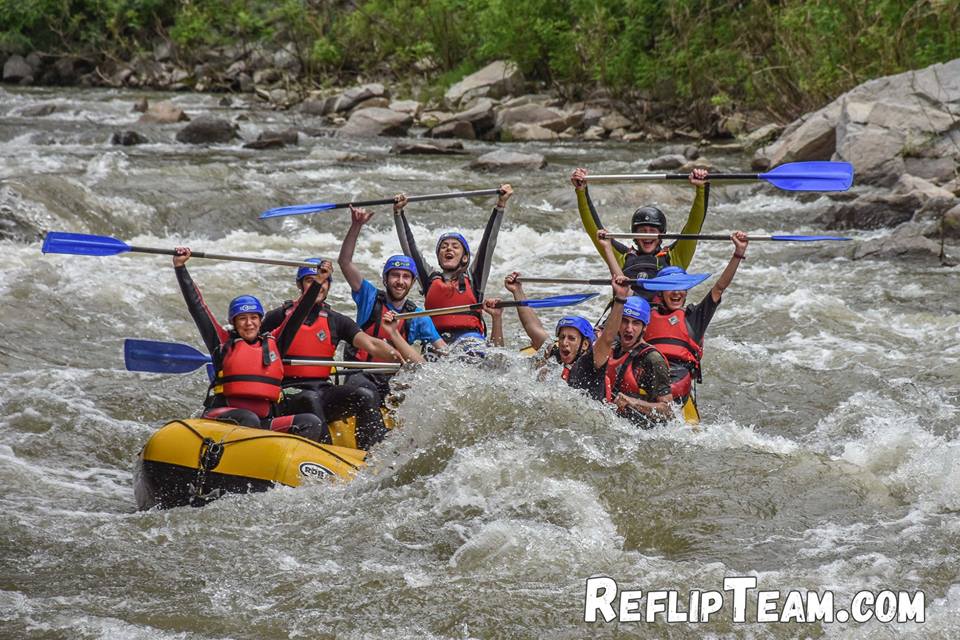
Rafting on the Struma River – the adventure you will remember forever!
If you are looking for a combination of adrenaline, nature and emotions, rafting on the Struma River is just for you!
Just an hour away from Sofia and Bansko, one of the most beautiful and dynamic routes in Bulgaria awaits you – the Kresna Gorge. Here, the mountain and the river meet to create the perfect scene for your next unforgettable day.
Descents every day from March to November
The rafting season on the Struma River lasts from March to November, and descents take place twice a day – at 10:00 and 14:00.
Whether you are a beginner or have already conquered several rivers, the route offers the perfect balance between fun and challenge – waves, rapids and moments that will make your heart beat faster.
Why choose Struma?
- The best rafting route in Bulgaria – dynamic, picturesque and completely safe.
- Professional and certified instructors who will take care of your safety and good mood.
- All necessary equipment is included – wetsuit, boots, jacket, helmet, life jacket, paddle and transport after the descent.
- Convenient logistics and quick access – only 120 km from Sofia.
- Incredible views and fresh air that will remind you why you love nature.
Suitable for everyone
Rafting on the Struma River is a wonderful experience for:
- friends looking for adventure;
- families with older children;
- corporate teambuilding and organized groups;
- anyone who wants to get out of their comfort zone and recharge.
No previous experience is necessary – just a desire for fun and adventure!
Memories that remain
Once the stormy waters have calmed down, you’ll be in for photos, laughter, and stories to tell long after.
Our team will capture every moment – from the first stroke to the final smile.
Are you ready for the adventure?
Come with us on a rafting trip on the Struma River and feel the freedom that only the river can give.
Sign up today and give yourself a day full of emotions, laughter and adrenaline!
Season: March – November
Descent times: 10:00 and 14:00
Location: Kresna Gorge, Struma River
Included: full equipment + transportation after the descent
More information can be found here.: https://reflipteam.com/rafting/rafting-struma/
2. A kayak for everyone
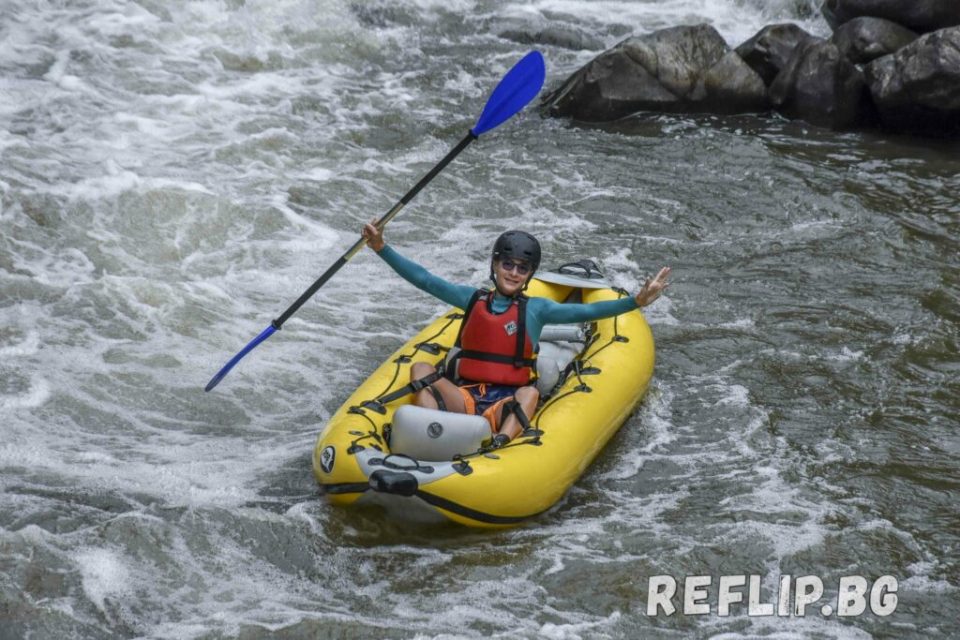
Kayaking trips every day. The best fun in the summer! The trip can be extreme or more relaxed, depending on your choice of season.
Canyoning for beginners
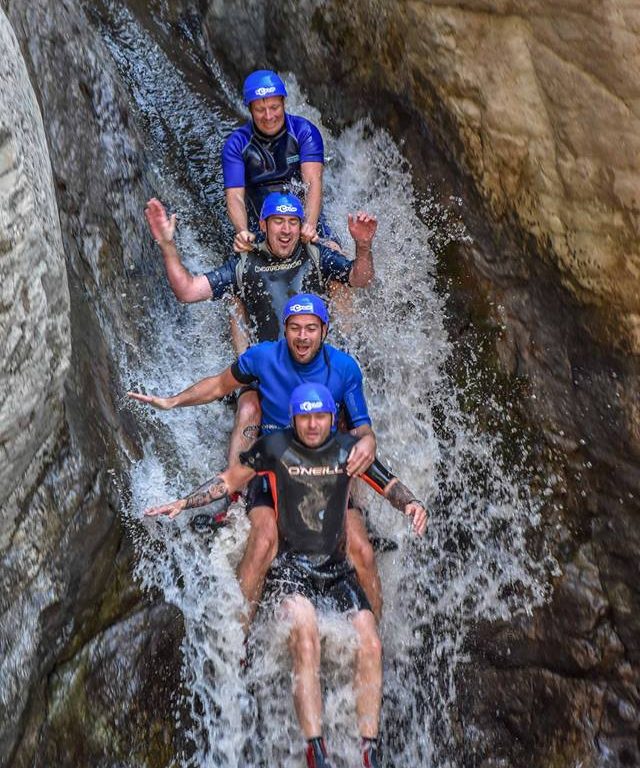
Canyoning for beginners in the Kresna Gorge!
Zip line over the Struma River
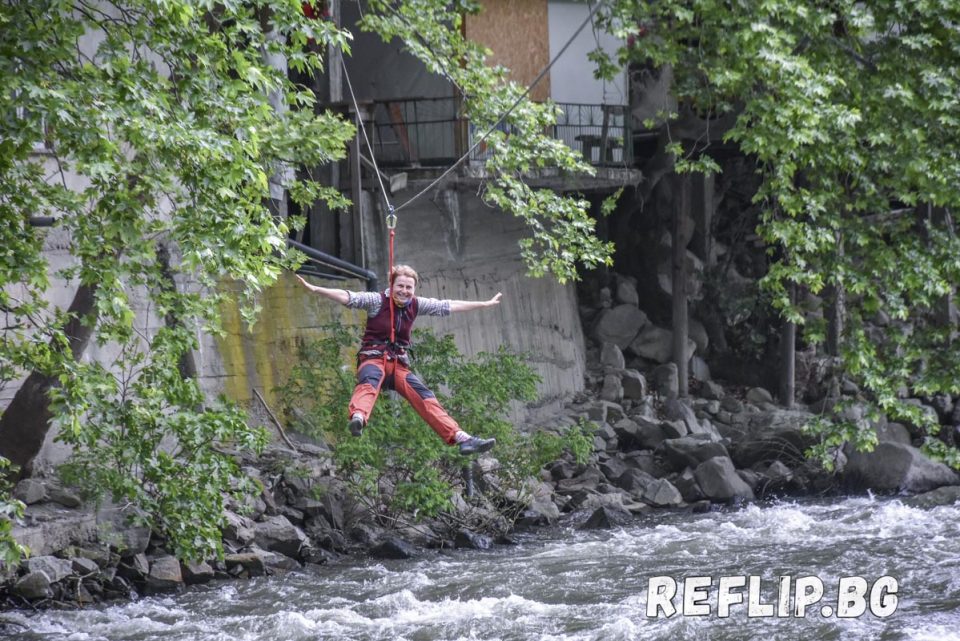
Ziplining or ZipLine is a relatively new extreme adventure that gives you a different perspective on the nature around you. The experience is suitable for both young and old.
Cycling
The entire area offers many opportunities for mountain biking. There are no marked routes, but whichever road/trail you take, you will be able to enjoy incredible views and experiences.
In case you do not have a bike, we offer bike rentals. If you are interested, contact us.
Sport fishing in the area
In the village of Stara Kresna there is a sport fishing complex with 3 reservoirs, and the objects of sport fishing are the fish – grass carp, carp and silver carp. Around each of the reservoirs, there are specially placed tables with benches for relaxation and drinking water fountains. The complex also has domestic animals (turkeys, chickens and rabbits).
You can also practice fishing on the Struma River, according to the statutory regimes.
Walk to the old church of the village of Stara Kresna, the monastery school (now a church)
The church is located about 300 m. from the Eco-Village. The first building you will see is the old monastery school, which is now used as a church. The old church is located behind this building. Testimonies show that the old temple was unique and of great dignity for its time. “St. Archangel Michael” is a Revival church and is part of the Nevrokop diocese. It has been declared a cultural monument. The holy monastery was built in 1856 on the site where there were several altars and two small chapels. In 1866, Spas Harizanov opened a mutual school in the porch of the temple. The church was burned down in 1878 during the pogrom of the Kresna-Razloj uprising and was rebuilt three years later. It was burned down again and burned to ashes in October 1912 during the Balkan War by the retreating Ottoman soldiers. The temple had two entrances – from the west for women and from the south for men. The floor is covered with baked bricks, and there are pots built into the walls for acoustics. In the current temple, some of the old icons, moved from the burned church, and the bell are preserved.
Visit to Oštava Mineral Baths or Gradesh Mineral Baths
The Oštava mineral baths, depending on their location, are divided into 2 thermal groups. One is the hot spring (Vrelata banya) near the village of Oštava, about 6 km from the Eco-village, not accessible by car. The building is abandoned and not maintained, the water temperature is 65◦. The other spring is warm (Hladkata banya), located 2.5 km from the Eco-village and housed in an unpretentious building built in the 1920s, but maintained. The water has a constant temperature of 38° and is very helpful in the treatment of the musculoskeletal system and diseases of the nervous system. Next to the Hladkata izvor there is also a small mud bath with 2 departments.
There is a marked walking route to both baths. The Hladkata mineral bath can be reached in 30-40 minutes from the Eco-village. You will need another 30-40 minutes to get to the Hot Bath from the Cold Bath. You can also get to the Cold Bath by car on a dirt road, in about 15 minutes.
The Gradeshki Mineral Baths are located 20 km from the Eco-Village. Mineral springs have been discovered on the territory of the Kresna municipality, localized in 4 main deposits – between the town of Kresna and the village of Dolna Gradeshnitsa, between the village of Stara Kresna and the village of Oshtava, near the villages of Gorna Breznitsa and Vlahi, with the Gradeshki Springs being the most developed to date. The Gradeshki Baths have 5 mineral springs with water temperatures from 20 to 68 degrees, the waters are clear, odorless and pleasant to drink. Suitable for the treatment of the musculoskeletal system, respiratory system, nervous system, gastrointestinal tract, etc.
Walk along the path to the railway station of the village of Stara Kresna
The path to the train station is a little more than 2 km long, passing through several forest tree belts and incredible views of the Kresna Gorge and the Struma River. The path is easy, with a low degree of difficulty, and is also suitable for summer hikes, as it is mostly in a forest. The path is part of an old Roman road, and in many places, stone retaining walls can be seen. Turtles, roe deer, and deer can be found along the path, and the plant species include oak, pine, chestnut, elm, blackberry, juniper, cactus, etc. The path is suitable for fans of extreme downhill biking.
Debeli Dab Ecovillage offers a guide along the trail and/or a transfer from the end of the trail to the Ecovillage. For more information, contact us.
Walk along the panoramic trail in the village of Stara Kresna
The path goes around the village, where you can enjoy views of the Malashevska, Rila and Pirin mountains.
Walk to the village of Senokos
The village of Senokos is about 9.5 km away and it will take you about 25 minutes by car to get there. The village is a convenient starting point for climbing Pirin Peak (2593 m) – the northernmost alpine peak of the mountain. But it also offers its visitors other routes of varying difficulty.
One of the places you can visit is the Sveta Marina area, where there is a centuries-old pine tree, an old sanctuary of the saint and a newly built chapel. It is believed that the tree has magical power and anyone who hugs it receives strength and energy. The thick trunk of the tree has literally grown through the rock. Near it is the “glued stone” – a rock to which small flat stones resembling a frame have been grafted. These stones are unique because the technology of gluing is unknown to archaeologists. No one can determine the method and purpose of this pouring of small stones onto the large rock from which the roots of the ancient pine tree emerge. The locals say that the stones have always been like this and it is not remembered in which era they were glued. If you stay at the place for a longer time, you can notice the rock resembling a lion’s head and the hole under it.
Until recently, there were several ancient trees in the Senokos area, perhaps older than the village. The ancient trees of the St. Nicholas and St. Todor sanctuaries were also known. One died from strong winds, and the other from a fire.
A characteristic of ancient trees is that they have always been perceived by people in these lands as holy, something like a symbol of divine power, and therefore no one encroached on them. For Bulgarians, who still venerate large trees today, the oak is a symbol of strength and wisdom, and according to some, the axis around which the world turns, while the pine is a symbol of immortality.
To reach the Sveta Marina area, start from the center of Senokos on a dirt road to the “Shirinata” area. After about 300 meters of climbing, the road is abandoned and you head west – to the right. You climb a small hill, on something that resembles steps with an improvised wooden railing. If you continue up the dirt road and pass Sveta Marina, you will reach wooden tables, on which the village assembly is arranged, since the site of the sanctuary itself does not accommodate all visitors. A wonderful view opens up to the east, towards Pirin Peak and to the west, towards Malashevska Mountain.
Another thing you can see is the Orthodox Church of St. Dimitar, which was built in 1894, burned down by the Turks in 1912 and restored in 1927, as well as the Chapel of St. George.
Walk to the village of Mechkul
The village is about 10 km from the Ecovillage and it will take you about 25 minutes by car to get there. There is a lot to see in the area of Mechkul village, and here are some of the sights:
- Church of St. Peter and Paul
- Chapel of St. Mina
- Rock megalithic complex (rock sanctuary)
- Vulture watching
- Mechkulska River and waterfall
There are several chapels and churches in the area. The church “St. Elijah” was built 3 km south of the village in 1805. A monastic school was opened next to it in 1836. It was destroyed two centuries ago, later an icon of Jesus Christ was found in the area, which is kept in the church in the village. In 1892 the church “St. Peter and Paul” was built, declared a cultural monument. Architecturally, it is a three-nave, stone-built, pseudo-basilica, without a dome and with an open porch to the south. The roof is gabled with tiles and has three metal crosses. The main entrance is from the west, and there is a second one from the south. To the northwest corner of the temple on a metal structure, is hung a bell, cast in 1898, which is decorated and has the founder’s inscriptions. The scene “The Last Judgment” is painted on the western facade. The frescoes and iconostasis were made by the Bansko icon painter Mihalko Golev in 1898 – 1899. The bishop’s throne, the pulpit, the forged candlesticks and the founder’s chairs are also valuable.
The megalithic rock sanctuary of St. Mina is located in the Amina area near the village of Mechkul. A small wooden sign is the only one that indicates the location of the rock complex, but you can also find its location on Google Maps.
The ancient rock-cult complex is located in the immediate vicinity of the chapel of St. Mina. From there, you can also observe the vultures in the area or go to the Mechkul waterfall.
Many decades ago, life was bustling in the area. The Crusaders, Roman and Thracian roads passed through here, and later – the Turkish post office. The wine road also passed near Mechkul. Once upon a time, there were fertile vineyards and huge quantities of wine were produced. Today, however, only the legends and the fabulous rock city have been preserved. Near the former ancient sanctuary are the stone “guards”. Since the complex has been poorly studied by archaeologists and historians, there are more legends than facts surrounding it. According to one of them, the huge rock massifs were arranged by the Titans themselves on the orders of Zeus. According to another, it is believed that there was an ancient sanctuary here. It was here that Alexander the Great received the prediction that he would conquer the world. There are still people who claim to know exactly on which stone the prediction was made.
One of the few pieces of information that archaeologists give us is that the place has been inhabited since 7000 BC and layers of different cultures have been discovered. When the lands of Ancient Thrace became part of the Roman Empire, a new sanctuary was built here. In the early Middle Ages, pagan gods were replaced by Christianity. Then, Saint Mina was chosen as the patron saint of this holy place. The local population has honored the saint for centuries and on his feast day (November 11), a kurban for health is served.
The history of the church that stands on the site today is equally mystical and exciting. It is connected with a prediction by Baba Vanga. A woman from the village of Mechkul was very sick. She went to the prophetess to seek a cure. Vanga told her to return to the village and make a kurban on the rocks in the “Amina” area. The woman did everything she was told and soon recovered. After the story spread, the locals decided that they should build a temple on this holy place. Thus, with common means and efforts, they erected the church of Saint Mina in 1950.
Tourist hike to the village of Vlahi
The tourist route from Stara Kresna to Vlahi is marked and takes about 4 hours.
Although the permanent residents of the village of Vlahi are about 10 people, it has a rich history and sights that are worth the difficult journey to it. There are two churches in the village – the main church on the square, which has been burned down and rebuilt many times, with the last building dating back to 1912, and the old church “St. Bogoroditsa”, which dates back to the 17th-18th centuries and is half-buried. It is located about 20 m to the right of the sharp bend at the beginning of the village. It is the oldest church in the area. Near the village are the famous Vlahinsky Waterfall and Vlahinsky Lakes. There are 4 active non-governmental organizations in the village – the “School for Nature” Foundation, the “Imagination” Association, the “Balkani” Wildlife Association and the “Semperviva” Association. The School of Nature Foundation manages the Eco-Center “School of Nature” – a center for applied environmental education and experiential learning in Southwestern Bulgaria. It is located in the building of the former Vlahi school, but the building was rebuilt, with only the foundations preserved. The “Imagination” Association and the “Sharaliya” Center maintain environmentally sustainable practices – a reed bed for water purification, a wind turbine, compost toilets, production of organic vegetables, fruits and fish and other activities. Their house is located on the central square. The “Semperviva” Association is engaged in the preservation of autochthonous breeds – herds of Karakachan goats (long-haired Kalaferska and Vitorog), sheep, Karakachan horses and Bulgarian shepherd dogs that guard the herds. They produce goat brine cheese and pastrami, as well as wool, from which remarkable Kukeri costumes are made. The Balkani Wildlife Association maintains an “Educational Center for Large Predators” in Vlahi. It has an interactive exhibition hall where you can learn more about the lifestyle and environment of wolves, bears, lynxes and jackals, a café, a souvenir shop, and a conference hall. The center also takes care of two bears and two wolves in large enclosures with a natural environment for them. These animals are ambassadors of nature, they were raised with people from a young age, they are socialized and react calmly to visitors. The bear and wolf enclosures can be reached by walking along the slope to the right of the school, crossing the bridge and taking the path up to the Barata neighborhood – first is the bear enclosure, and further up – the wolf enclosure. In Barata are the houses and enclosures for the animals of the Semperviva Association. It is not recommended to pass there without an escort from the center of the Balkani Social Democratic Party or from the village, because there are shepherd dogs guarding the animals. If you do pass there alone, under no circumstances go towards the herds of goats and sheep.
Tourist hike to Zagaza hut
The tourist route Stara Kresna village – Zagaza hut is marked, its duration is about 5.5 hours, with a length of 26 km.
Zagaza hut is also a starting point for several tourist routes, such as: Sinanitsa hut, Yavorov hut, Banderitsa hut, Vihren hut through the marble ridge of Pirin or Vlahini lakes.
Visit to Tisata Park
“Tisata” is a reserve located on the territory and near the northern slope of the Pirin Mountain in the southern part of the Kresna Gorge. Tisata was created with the aim of preserving the largest natural deposit of juniper trees not only in Bulgaria, but also in all of Europe. Over the years since its creation, the reserve has repeatedly changed the territory it occupies. Trees cover nearly 80% of the reserve’s territory, as the main representative of the tree species in Tisata is the juniper tree. It is a protected plant species originating from Asia Minor. Trees of this species with a height of over 20 m are found. In addition to juniper trees, there are also the hairy oak, hornbeam, winter oak, holm oak, black pine and others. The shrubs are mainly represented by the species of flu, red juniper, dracaena and jasmine. The fauna is mainly represented by animals characteristic of the southernmost parts of Europe. A large number of animal species that are found in the Tisza are rare in Europe. A very large number of birds are found, which is why the reserve, together with the buffer zone and the surrounding areas, has been declared territories of special importance for ornithology. The reserve is one of the seven areas in Bulgaria where the Mediterranean species Spanish stonechat, mountain partridge, rock nuthatch, white-fronted shrikes and black-headed bunting, etc. are protected. A large number of animals that are found in the Tisza are listed in the Red Book of Bulgaria.
Visit to the village of Gorna Breznitsa and the Kuchkarnika protected area
This place will surprise and inspire you with its majestic centuries-old plane trees. Here, the size of a person is insignificant compared to the size of the trees. A place where children can play with nature and adults can hold their breath. The protected area “Natural Plane Tree Habitat – Kuchkarnika” is of essential importance for the preservation of riverside plane trees (Platanus orientalis) over 300 years old and has an area of over 11 hectares. Another protected area in the region – “Natural Plane Tree Habitat – Buina”, also for the preservation of plane trees over 300 years old, but with an area of just under half a hectare.
From the Eco-village to the village of Gorna Breznitsa, there are 16 km. and there is definitely something to see. Of the cultural and religious sites, the monastery of St. Prophet Elijah is of interest. The village also has a mineral spring with a water temperature of 36-38◦C. Suitable for the treatment of lung, bone-joint and skin diseases. On the hill of the village, in the courtyard of the monastery “St. Prophet Elijah” there is an old Roman fountain with healing water, testifying to the use of mineral waters in Gorna Breznitsa since ancient times.
Visit to the village of Ilindentsi
From the Eco-village to the village of Ilindentsi, you are 28 km away. Every year, the international sculpture symposium “Art Center” – Ilindentsi is held in the village. There is a marked eco-trail, starting from the sculpture symposium, passing through the rock complex “Zandana”, the spring “Tears for the Killed”, continuing through incredible rock formations and natural landmarks, including part of the caves and continuing into the territory of the Pirin National Park. The high-mountain lakes and pastures form a unique landscape. Every year, on the first Saturday of February, a Wine Fair is held in the village. The rite includes: welcoming the gods of wine and fertility and announcing the king of the vineyards. The village is the center of the famous grapes and wine produced from them – Keratsuda. The variety was brought by refugees from Aegean Macedonia, who settled there in 1912. Each family in the village grows from 0.5 to 5 decares of this grape variety and produces wine from it. The folk festival of the village of Ilindentsi, dedicated to the Ilinden-Preobrazhensko Uprising, is celebrated from August 1 to 3. Above the village there is a healing spring, next to which a beautiful chapel complex has been built. Above the village are also the largest marble quarries on the Balkan Peninsula. Two factories for processing marble and producing marble products are located 3 kilometers from the village. There are over 20 workshops for producing marble products in the village.
Visit to tourist sites in the town of Kresna
The town of Kresna is 15 km from the Ecovillage. Some of the sights you can visit:
- Church-ossuary “St. Ivan Rilski” from 1939, known for its unique iconostasis with openwork carving. Monument of culture.
- Remains of the ancient city of “Neine”, discovered near Kresna in the area of Hilyadnitsa and Rukalot from the 1st-3rd centuries.
- The Kresna Earth Pyramids Melo. In the eastern part of Kresna, right opposite the train station, are the almost unknown “Kresna Earth Pyramids – Melo”. These unique natural forms are beautiful sand screes. In origin, they are similar to the Melnik Earth Pyramids, but differ from them in their lack of diversity in forms.
- Before the city, on a picturesque bend of the Struma River, there is a monument to those who died in the Kresna-Razlog Uprising (1878)
Visit to the Church of the Holy Trinity, Krupnik village
Krupnik village is located 22 km from the Eco-Village. The church in Krupnik village is located in the southeastern corner of Krupnik village, about 600 m from the village church in the center of the village. It is located on a level terrace, from which a wonderful view opens up to the entire Simitliysko-Krupnik valley and to the entrance to the Kresna Gorge. The church was the cathedral of the Krupnik bishopric, later a metropolis, which existed until the second half of the 16th century. It was destroyed with the Turkification of the village in 1670 and a mosque was erected in its place, which collapsed in 1904 from the Krupnik earthquake, and the foundations of the minaret are still visible today. Nowadays, a chapel “Holy Trinity” has been built near the church.
Свържи се с нас
Всеки ден от 10 до 20 часа.
Ако не ти вдигнем, значи работим по двора.
Можеш да ни пишеш и тук:
Get in touch with us
Every day 10 – 20 h.
If we don’t pick up, it means we’re working in the yard.
You can also write to us here:
